Typical tracker ticket
"Fix checkout problems"
- Requirements are hidden in comments or meetings.
- Agents must guess scope, tools, risks, and test path.
- Done means somebody moved the status column.
Agent action: blocked until a human rewrites the work.
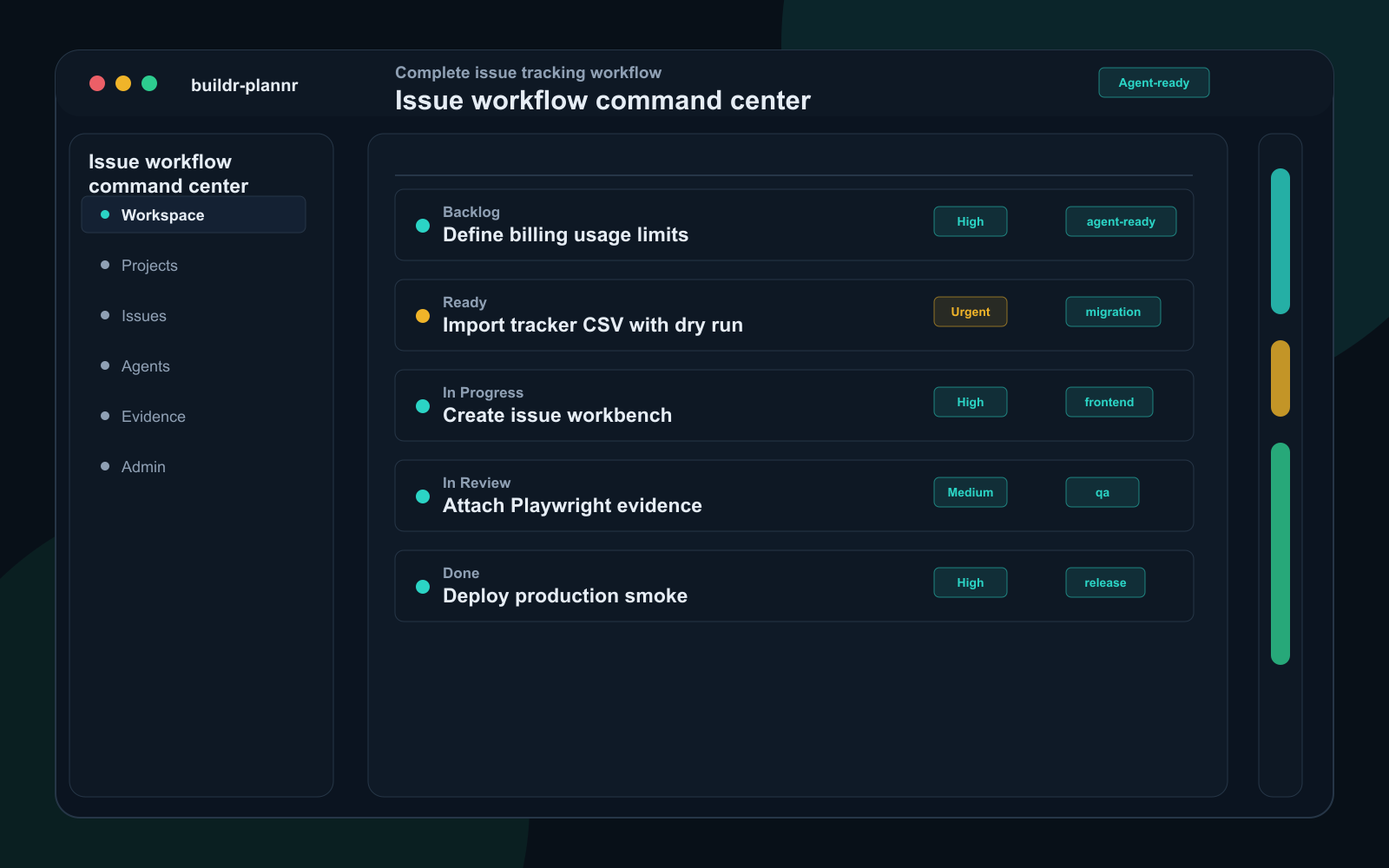
Human issue tracking with agent execution control
Plan work like Linear. Govern it like a production system. Give agents the context, permissions, approvals, and evidence requirements they need to safely complete software tasks.
Jira, Azure DevOps, and Linear track work for humans. buildr-plannr prepares work so AI agents can safely execute it.
Every ready issue becomes an execution packet with four required parts before an agent starts.
12
Ready
Contracts complete, dependencies clear
4
Missing context
Needs repo hints or environment notes
3
Needs approval
Awaiting human review before mutation
7
Verification
Evidence required before acceptance
Why teams switch
The board still works for people, but every item can become a safe handoff packet: task contract, context pack, execution policy, evidence checklist, and agent queue priority.
| Instead of | buildr-plannr gives you |
|---|---|
| Jira tickets with vague requirements | Agent-ready task contracts |
| Linear issues optimized for humans | Queues optimized for humans and agents |
| Azure DevOps process-heavy workflows | Lightweight execution control plus evidence |
| Comments scattered across issues | Structured context packs and approval history |
| "Done" as a status | "Done" backed by proof |
Typical tracker ticket
Agent action: blocked until a human rewrites the work.
buildr-plannr task contract
Agent action: safe to claim after approval and quota checks pass.
Agent-ready issues
Contracts
Every work item can become a scoped execution packet.
Human control
Approval gates
Risky agent actions can require explicit review.
Proof of work
Evidence
Completion depends on tests, logs, and reviewable output.
Clear buyer answer
Customers should not need to decode the category. Existing trackers coordinate humans; buildr-plannr adds the contracts, context, policy, queues, billing controls, and evidence that make AI execution governable.
Jira can model almost any human process. buildr-plannr adds the missing execution layer agents need: scope, non-goals, allowed tools, trusted context, approvals, and proof before work begins.
Linear is excellent for fast human teams. buildr-plannr keeps that clarity while making every ticket executable by Codex, Claude Code, Cursor, and other agents without losing owner control.
Azure DevOps is a broad engineering suite. buildr-plannr is the lighter agent handoff and governance layer that can sit beside existing repos, CI, docs, and release processes.
A ticket is not done because a status changed. It is done when the original contract has passing tests, evidence, approvals, and a reviewable outcome.
Capture goal, scope, non-goals, constraints, expected output, verification commands, and rollback notes before an agent starts.
Generate Markdown or JSON bundles with dependencies, linked docs, activity, repo hints, and environment notes.
Separate ready work from missing-context, blocked, needs-decision, needs-credentials, and verification states.
Require review for sensitive agent actions such as live issue edits, exports, dependency changes, and scheduled runs.
Require commands, tests, screenshots, logs, PR links, coverage deltas, and residual risks before accepting completed work.
Use named agents, scoped tokens, metered runs, audit trails, and tiered limits to keep automation controlled.
Expose ready work, context packs, status updates, comments, time logging, evidence, and approvals to Codex, Claude Code, Cursor, and other MCP-capable agent clients.
Built around agent execution
A normal issue tracker can tell an agent what the team wants. buildr-plannr tells the agent what is allowed, what context is trusted, what proof is required, and when a human must approve.
Every issue defines scope, non-goals, tools, constraints, acceptance criteria, and approval rules.
Agents get the right files, docs, links, architecture notes, and prior decisions before starting.
Owners control what agents can do, where they can act, and when human approval is required.
Work is not complete until tests, logs, screenshots, PRs, and risk notes are attached.
Work is prioritized by readiness, blockers, permissions, and run quota, not just status.
Usage limits, plans, billing, and enterprise controls are built around agent work.
Product story assets
The marketing media set is designed as a product tour: human planning, issue movement, agent handoff, governance, proof, migration, billing, and operations in one cohesive story.
Feature tour
A short product tour covering issue creation, planning hierarchy, agent handoff, approvals, evidence, imports, billing, and admin controls.
Issue tracking
Showcases issue creation, status movement, priority, labels, stage columns, comments, and blocker visibility.

Planning model
Positions buildr-plannr as the structured workspace for project hierarchy, cycle planning, dependencies, risks, and roadmap views.
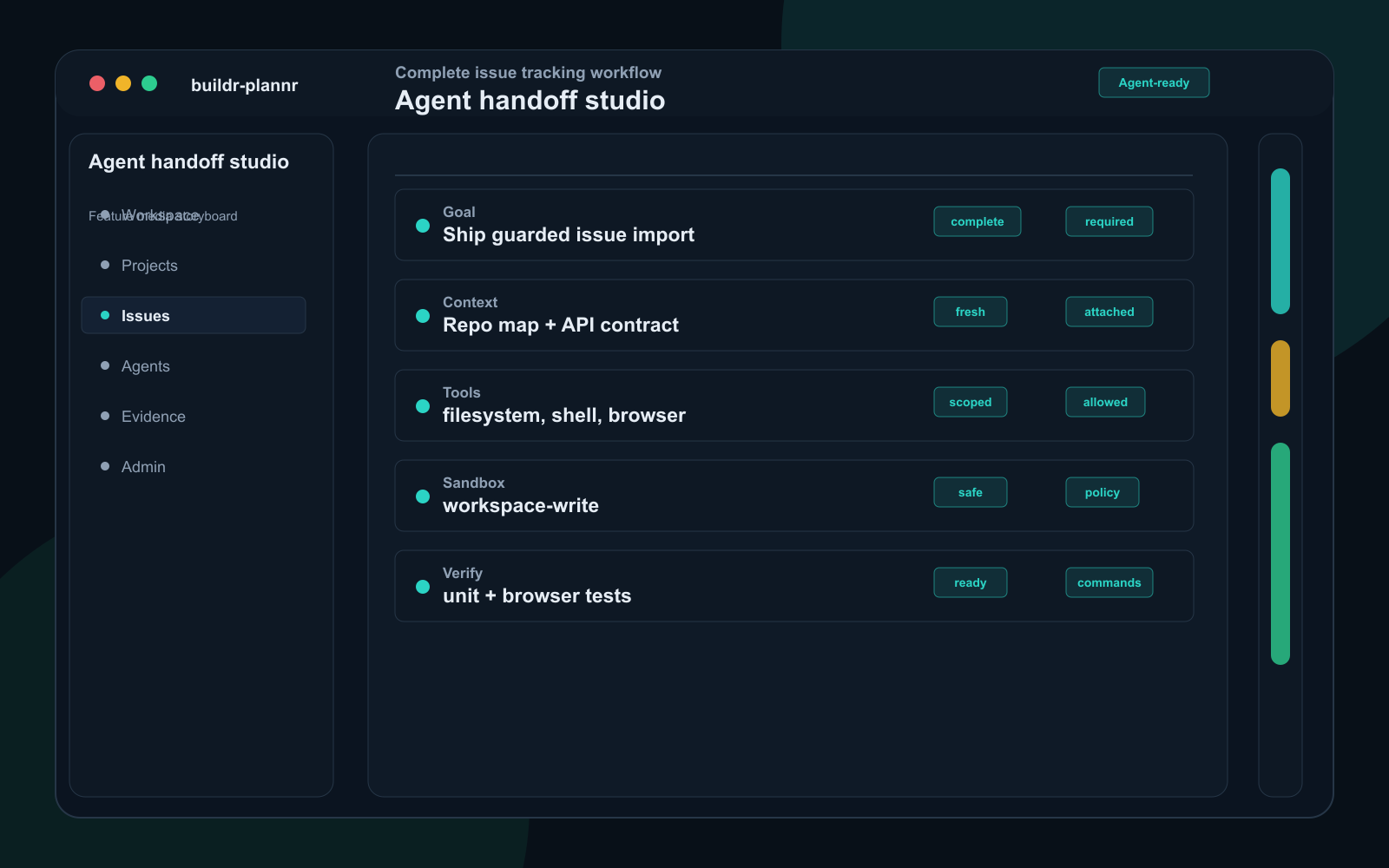
Agent handoff
Shows how a human turns intent into agent-ready work with scope, non-goals, constraints, context, allowed tools, and verification commands.
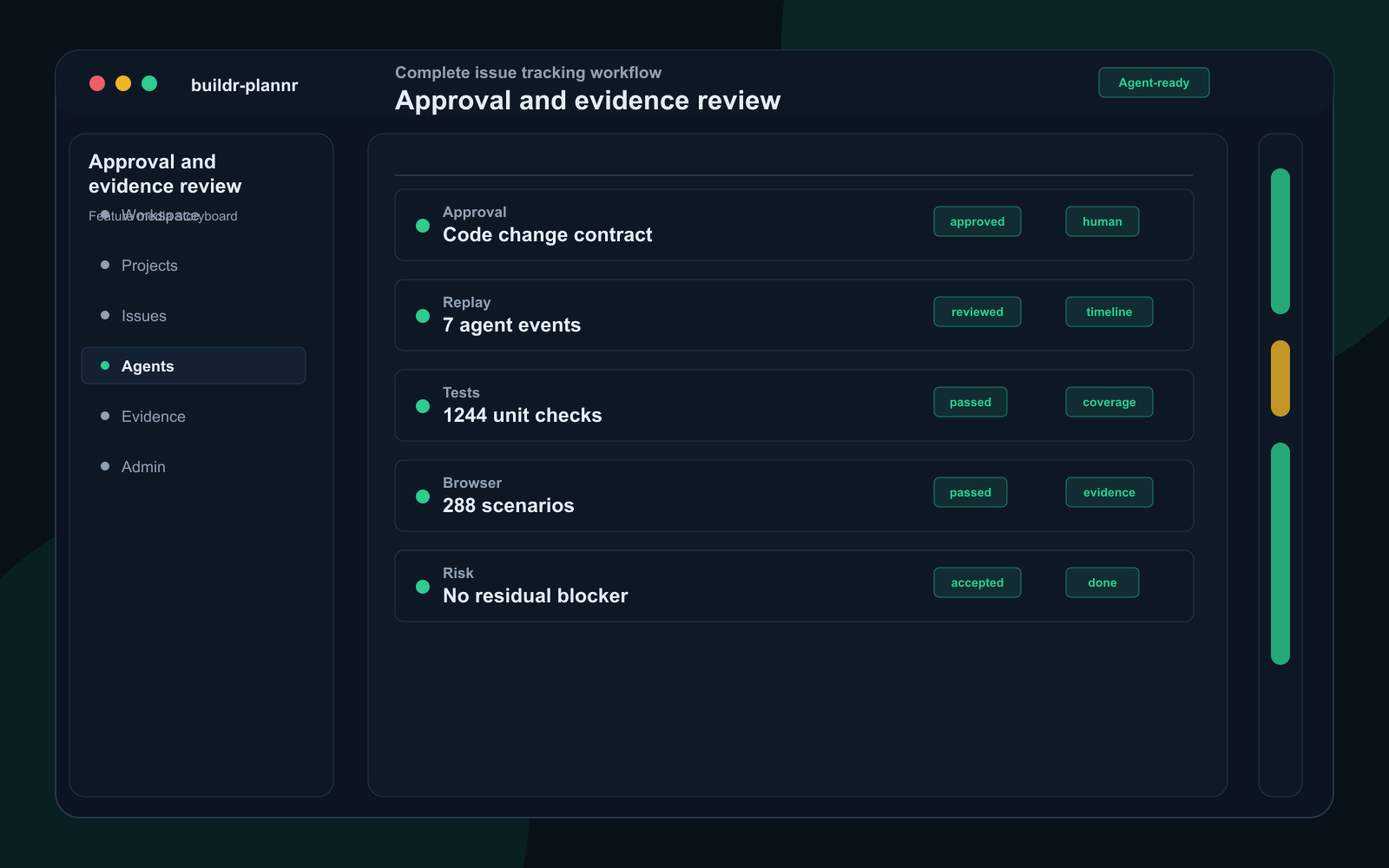
Governance
Explains the human control loop: approval gates, run replay, outcome evidence, residual risk, and acceptance criteria before Done.
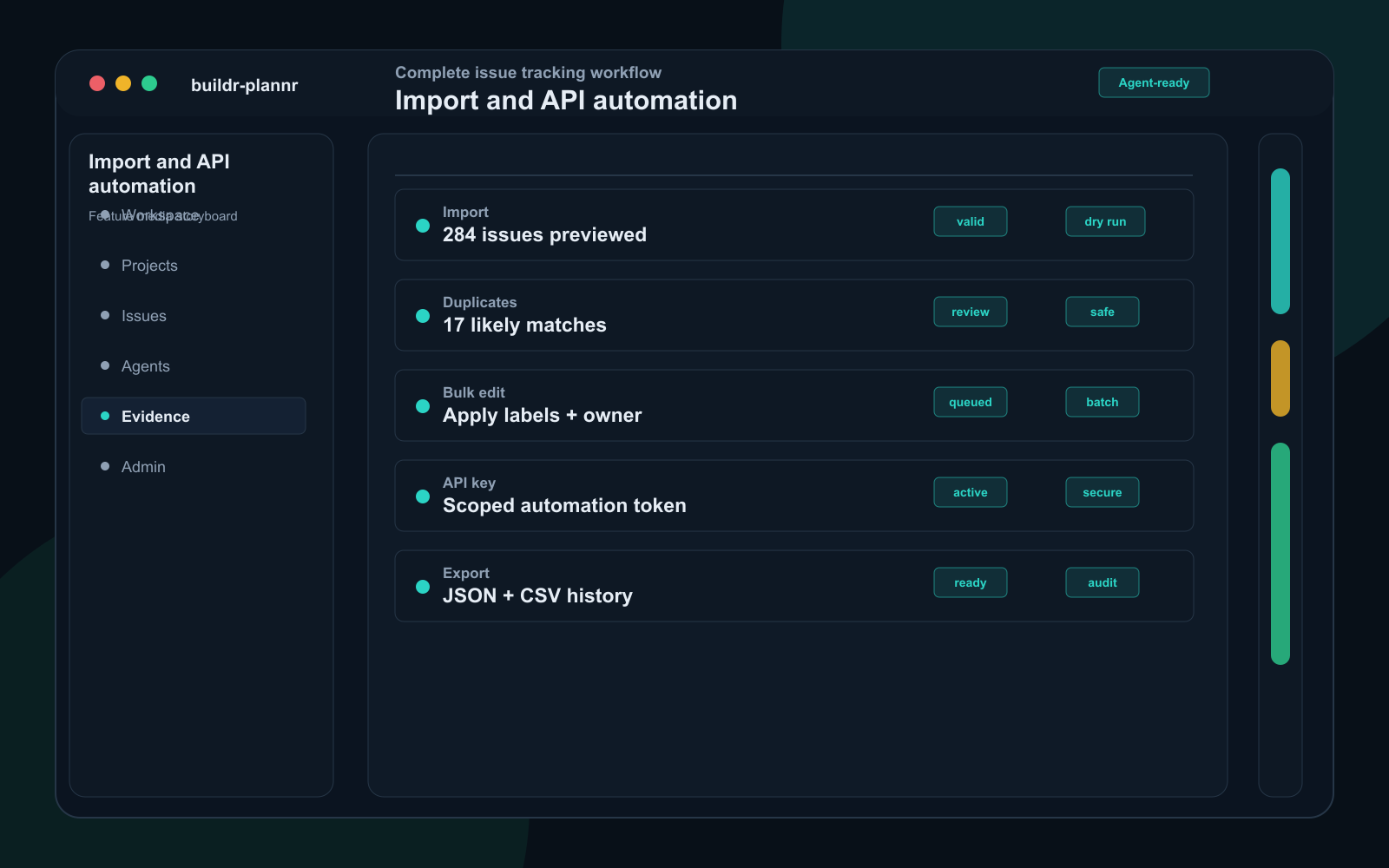
Migration and API
Highlights migration support, dry-run diffs, duplicate detection, bulk edits, API keys, and agent-ready automation endpoints.
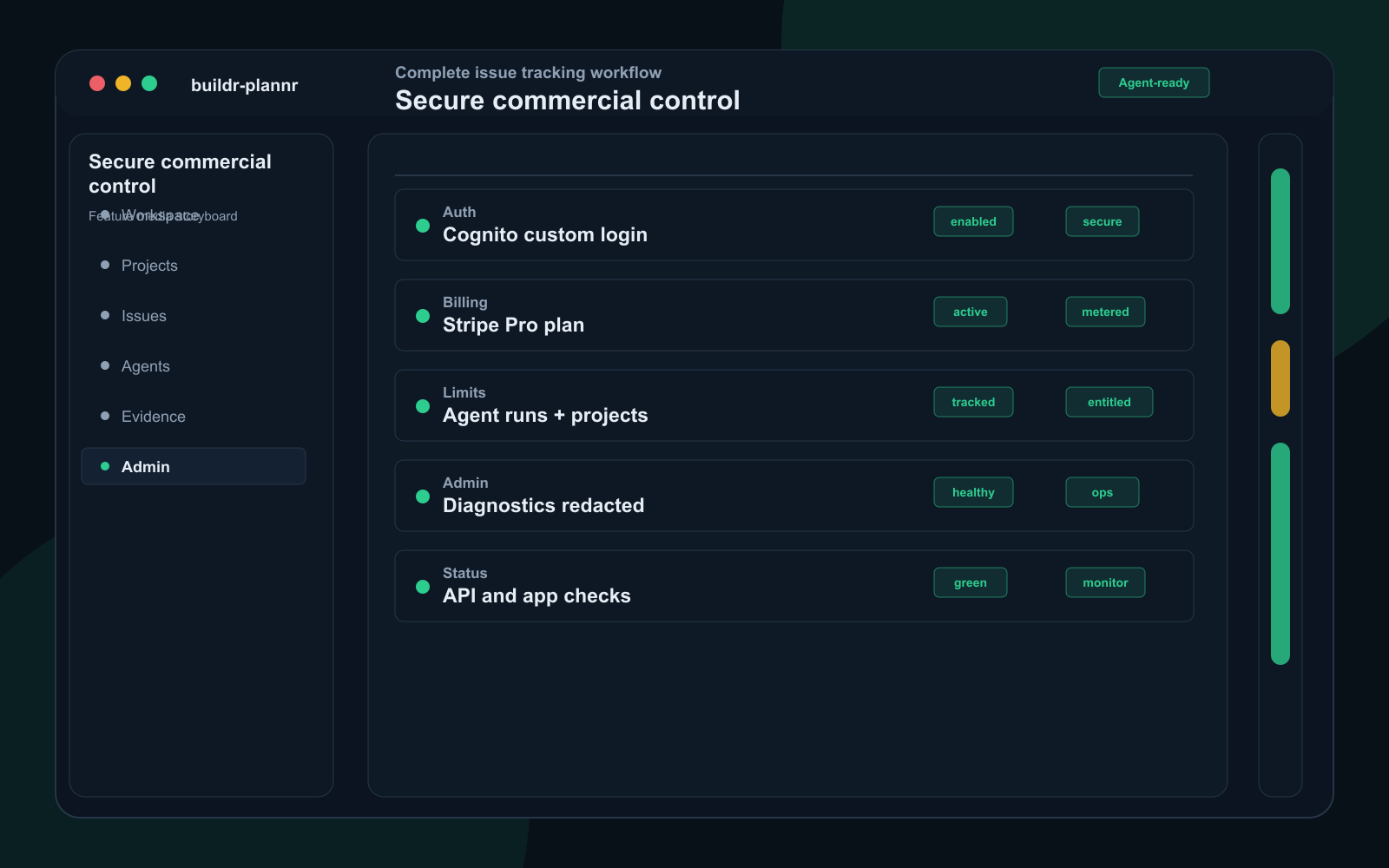
SaaS operations
Covers the commercial and operational surface: secured app access, subscriptions, plan entitlements, admin diagnostics, security posture, and status monitoring.
Human plus agent delivery
Agent speed only matters when a human can explain, constrain, and accept the work. buildr-plannr keeps those decisions visible from planning through verification.
Defines intent, scope, non-goals, dependencies, approval rules, and the evidence required for acceptance.
Claims only ready work with the right context pack, allowed tools, blocked actions, and verification commands.
Accepts completion when tests, logs, screenshots, pull requests, and residual risks match the original contract.
Built for governed agent adoption
buildr-plannr is strongest when a team already has agents in the workflow and now needs clearer scope, context, permissions, approvals, and proof before the work is trusted.
Standardize how teams hand work to coding agents without losing security, approvals, or verification evidence.
Turn product intent, dependencies, and acceptance criteria into scoped agent task contracts before implementation starts.
Coordinate several agents across product, code, QA, and release work while keeping a human review path for risky changes.
Paid conversion path
The funnel is designed to prove value before pushing payment: plan intent is captured at signup, workspace activation happens first, and Stripe checkout follows when limits or governance needs are clear.
Start free or select a paid tier when agent volume, integrations, exports, or approval controls matter.
The selected plan stays attached while the owner creates the secured workspace and first project.
Activation is the first agent-ready issue with a task contract, context pack, and verification evidence.
Billing starts from clear usage pressure: agent runs, projects, API access, retention, and governance.
Agent workflow comparison
Keep the tools your team already trusts for planning, coding, docs, and CI. buildr-plannr specializes in the handoff layer those tools depend on when agent work needs to be scoped, governed, and accepted with evidence.
Organize human work, delegate issues, and summarize workspace context.
buildr-plannr makes the work agent-ready first: scope, context, permissions, approvals, and evidence are explicit before execution.
Execute implementation tasks, run commands, and open branches or pull requests.
buildr-plannr defines the task contract those agents should receive and keeps human acceptance tied to proof, not just a generated PR.
Store knowledge, run checks, and automate fragments of the delivery path.
buildr-plannr connects planning intent to reusable context packs, governance policy, and verification records in one workflow.
Competitor decision guide
The difference is not another board. Jira, Azure DevOps, and Linear are excellent human work trackers; buildr-plannr adds the execution layer agents need: task contracts, context packs, policy, readiness queues, usage controls, and evidence-based Done.
| Competitor | What they do well | buildr-plannr advantage |
|---|---|---|
| Jira | Deep enterprise workflow configuration, backlogs, issue types, reports, and mature governance for human teams. | Keep configurable workflows, then add agent task contracts, context packs, run policy, evidence requirements, and MCP access so work is executable by agents without losing control. |
| Azure DevOps | Strong end-to-end engineering suite with boards, repos, pipelines, dashboards, and Microsoft ecosystem alignment. | Focus the planning layer on agent readiness: the board tells humans what is blocked, and the remote API tells agents exactly what they may do next. |
| Linear | Fast, elegant issue tracking with projects, cycles, views, triage, and keyboard-first team workflows. | Preserve speed and simplicity while making every issue safe for automation: scope, permissions, approvals, evidence, reminders, and time signals are first-class. |
Public launch readiness
Go/no-go stays blocked until AWS, Cognito, Stripe, domain, legal, support, incident, and customer evidence are captured with accountable owners.
Agent value path
First workspace success must show a task contract, context pack, approval rule, and evidence loop before paid launch pressure increases.
Secure workspace access
Cognito auth, protected app routes, scoped agent access, audit events, and dev-site protection need deployed proof before public launch.
Billing and entitlements
Plan limits, Stripe checkout, portal recovery, downgrade handling, and enterprise handoff must match the typed entitlement model.
Go/no-go decision
Launch only proceeds when product, security, billing, infrastructure, support, and customer trust owners accept their gates.
All launch-blocking gates have external evidence and an accountable owner.
Rollback owner, communication owner, and launch window are recorded before release.